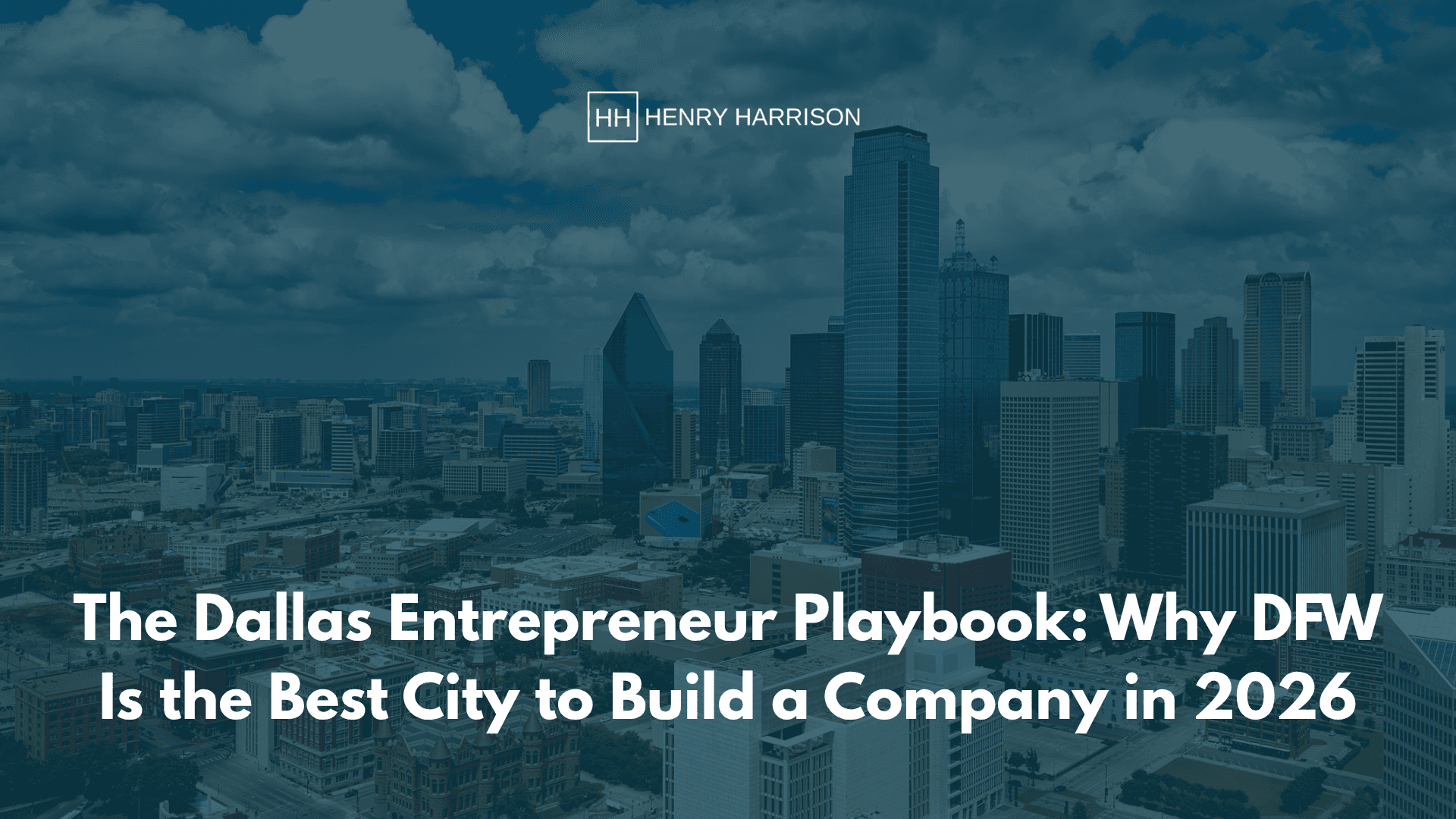
The Dallas Entrepreneur Playbook: Why DFW Is the Best City to Build a Company in 2026
By Henry Harrison
At a young age, I moved my life to Dallas from the Washington, D.C. to start my first business. The Washington DC area home building business was in a bit of slump and I researched the country to find what I thought would be the best place to start my own homebuilding company. I also liked Dallas and Texas. The people, the business climate, the optimism in the air, the weather, airport, road system and location with in the U.S.
Twelve companies later, I could not have imagined what a booming place this would have been. If I were starting over today as a Dallas entrepreneur, I'd make the same move twice as fast. The Dallas–Fort Worth metroplex has quietly become the single best place in America to build a company that's meant to last — not because it's trendy, but because every operational variable that matters to a founder tilts in your favor here. Capital. Customers. Cost. Talent. Taxes. Networks that actually pick up the phone.
This is the playbook I wish someone had handed me. It's also the one I'd give my loved ones if they came to me tomorrow saying they want to build something.
Let's get into it.
The Numbers: DFW vs. Austin vs. Houston vs. Everywhere Else
I want to start with the data because the "is Texas a real business hub or just a meme" debate should have ended five years ago, yet it somehow hasn't.
Dallas–Fort Worth has now ranked #1 in the United States for corporate headquarters relocations seven years running, going back to 2018. According to CBRE's most recent analysis, DFW pulled in 11 interstate or international HQ relocations in 2025 alone — the most of any U.S. metro for that year — and another seven companies relocated within the region. Across the longer window from 2018 through 2025, the Metroplex has captured more than 100 headquarters moves, more than any other region in the country.
For comparison: Austin landed 81 in roughly the same window. Nashville pulled 35. Phoenix and Houston each landed 31. The Bay Area lost 156. This is not a marketing slide. It's a structural realignment of where American business gets done.
The dollars follow. The combined market capitalization of public companies headquartered in DFW has roughly doubled since 2018 to around $1.5 trillion. The region is home to more than 20 Fortune 500 companies — AT&T, Texas Instruments, American Airlines, ExxonMobil, Charles Schwab, McKesson, CBRE, Caterpillar, Toyota Motor North America, the list goes on. Recent headlines include KFC moving its U.S. headquarters to Plano, Care.com relocating to Uptown Dallas, and AT&T announcing a new global headquarters campus also bound for Plano by 2028.
Austin gets the press because the press lives in Austin. Houston has the energy weight and a Texas Medical Center that's a world unto itself. Both are fantastic cities. But if you're trying to choose a Texas metro to build a company in — not just party in or extract oil from — Dallas is where the customers, the capital, and the operating leverage actually converge.
The TL;DR: Texas is no longer a contrarian bet. Inside Texas, Dallas is the operating capital.
The Four Industries Pulling Founders to Dallas
People assume DFW is one thing. It's not. It's at least four distinct economies stacked on top of each other, and you can build a real company in any of them.
Financial services. Dallas has quietly become one of the most important financial centers in the country, behind only New York for total industry employment. Goldman Sachs is finishing an 800,000-square-foot campus here. Wells Fargo, JPMorgan, and Bank of America all have massive North Texas operations. ScotiaBank, Deutsche Bank, and Charles Schwab anchor the region. For a founder, that means real B2B customers with real budgets and real procurement cycles — and a talent pool of finance operators who can be hired without flying anyone in.
Industrial, logistics, and energy. This is where I've spent a lot of my own career, and it's the part of the Dallas economy most outsiders underestimate. DFW sits at the intersection of two interstates that move a meaningful percentage of America's freight. The region has more than 30 industrial parks of consequence, the world's busiest cargo airport at DFW International, and a rail backbone that connects Mexican manufacturing to U.S. distribution. Energy — both legacy oil and gas and emerging waste-to-energy, solar, and grid technology — runs through the region in a way that no other U.S. metro can match.
Healthcare and life sciences. Less hyped than Houston's Med Center, but no less serious. UT Southwestern, Children's Health, Baylor Scott & White, and Texas Health Resources collectively employ tens of thousands of clinicians and researchers. Pegasus Park, the Lyda Hill–backed bioscience campus, has become a real magnet for medical innovation. If you're building anything in healthtech, devices, biotech, or services to providers, the customer density here is excellent and the regulatory environment is workable.
Technology and AI. The newest of the four. A decade ago this would have been an exaggeration. Today it's just the truth. DFW startups raised more than $1.6 billion in venture capital in 2025 alone, with the ecosystem now ranked among the top startup metros in the country. Sequoia, Andreessen Horowitz, and Kleiner Perkins all wrote Dallas checks in the past two years. Local funds like Perot Jain, Trailblazer Capital, Goldcrest, and Dallas Venture Capital are active and growing.
If you're a founder, the question isn't whether your industry has a presence in Dallas. It's whether you've mapped which of these four economies your company plugs into — and then plugged in.
Capital Access: PE, VC, Family Offices, and the Banks That Still Lend
Here's where Dallas separates itself from Austin in a way that doesn't get talked about enough: the capital stack here is complete.
In Austin, the dominant capital story is venture. That's great for a small subset of companies — fast-growing software businesses that look like they could go public — and not particularly useful for the other 95% of businesses that need to get built.
Dallas has venture, yes. But it also has one of the deepest concentrations of private equity capital outside of New York. It has more than $1 trillion in family-office wealth across hundreds of single- and multi-family offices, many of which actively invest in operating businesses. It has private credit funds, mezzanine lenders, real-estate-backed lenders, and SBA-active community banks — Texas Security Bank, Veritex, Frost — that will actually look at deals other markets reject.
I've raised money in nearly every flavor across my twelve companies, and what I tell founders is this: figure out which kind of capital fits your business, then find the Dallas pocket that specializes in it.
A waste-to-energy project doesn't get funded by VCs. A homebuilder doesn't get funded by family offices the same way a B2B SaaS company does. A bootstrapped operator with $4M of EBITDA shouldn't be talking to growth-stage venture firms. Most founders waste eighteen months pitching the wrong pool of money. The Dallas advantage is that here, the right pool actually exists, somewhere, for almost every legitimate business model.
A few practical notes. Local VCs in Dallas — and I say this with affection — tend to be more conservative than coastal funds. They like real revenue, clear unit economics, and a path to profitability. If you're a "growth at all costs" founder, you'll get further with the West Coast firms now active here than with the legacy local ones. If you're capital-efficient and disciplined, the Dallas VC community will love you.
Family offices and private equity are where the real money lives, and they don't have websites you can Google. You meet them through people. Which brings us to the next section.
Talent: The Schools, the Pipelines, and the Relocations
A lot of cities can attract executives. Few can build them. Dallas does both.
The home-grown pipeline runs through three universities. SMU — where I did my MBA — has the Cox School of Business, the Caruth Institute for Entrepreneurship, and an alumni network that disproportionately ends up running North Texas. UT-Dallas has built one of the strongest STEM and business analytics programs in the South, with a particularly strong management school. TCU in Fort Worth produces a steady stream of operators, especially in finance, real estate, and energy. Outside the metro, Texas A&M, Baylor, and UT-Austin all funnel grads to Dallas at meaningful scale.
But the bigger talent story in DFW isn't local — it's inbound. Every relocation I mentioned earlier brings hundreds or thousands of employees. AT&T's new Plano campus will consolidate three Dallas-area offices. TIAA dropped 700+ employees into Frisco. Goldman Sachs is bringing thousands more.
For a founder, this matters in a way that's easy to miss. You're not just competing for talent against other Dallas startups. You're also competing against well-capitalized Fortune 500s that pay top of market. That's the bad news.
The good news: those Fortune 500 employees often want out. The people who took the relocation package in 2021 to escape California are now three years into corporate life, and the entrepreneurial itch is real. The best executive hires I've made in the last decade have been recovering corporate operators who got tired of the politics and wanted to build something. Dallas has a deep bench of these people, and they're hungry.
One more thing on talent: cost of living, while no longer cheap, is still meaningfully more livable than the Bay Area, New York, or Boston. That matters for the senior people you're trying to recruit who have families and won't move for a 10% bump.
The Networks That Actually Matter
If I had to name the single biggest reason Dallas has worked for me, it would be the networks. Not LinkedIn. Real, in-person, peer-to-peer networks where the price of admission is having actually built something.
Entrepreneurs' Organization (EO). I was president of the Dallas chapter and a member for many years before that. EO is for founders running businesses with at least $1M in annual revenue, and the value is the forum — a small confidential peer group that meets monthly. There is no better cure for the loneliness of founder life. The Dallas chapter is one of the largest and most active in the world.
Young Presidents' Organization (YPO). A step up in scale (the requirement is leadership of a company with significant revenue and employees) and a step up in formality. YPO connects you to operators globally, and the Dallas YPO community is robust. I was a member for years and still draw on the relationships.
Vistage. Membership-based CEO peer groups with a facilitator and a structured methodology. Many Dallas CEOs swear by it. I'd describe it as more structured than EO, less networked than YPO. Worth a look depending on what you need.
Industry-specific. Dallas Regional Chamber, North Texas Commission, Dallas Citizens Council, and Dallas Innovates all play different roles. The Dallas Regional Chamber in particular is the best economic development organization in the country, and they will help a serious relocating company in ways that border on absurd.
The thing I tell founders new to Dallas: pick one peer group and one industry-specific organization. Show up consistently for two years. Do not network with a transactional mindset — Texans can smell that from three counties away. Show up to help, contribute genuinely, and the relationships compound in ways that make the rest of the playbook work.
The Tax and Regulatory Reality Check
Let's talk about money the state doesn't take from you, because this is real and structural.
No state personal income tax. This is the headline, and it's true. If you live in Texas, your W-2 income, your distributions, your capital gains — none of it is taxed at the state level. For a founder approaching a liquidity event, this alone is often worth six or seven figures.
Property taxes are higher than you'd guess. Texas funds itself somehow, and it's largely through property tax. Effective rates of 2–2.5% on assessed value are normal in DFW. If you're buying a $1.5M home, you're paying $35K+ in property tax a year. Worth knowing.
The franchise tax. Sometimes called the "margin tax" — Texas's substitute for a state corporate income tax. For the 2026 report year, the no-tax-due threshold is $2.65 million in annualized total revenue, up from $2.47 million the year before. That means if your Texas-sourced revenue is below $2.65M, you owe zero franchise tax — though you still have to file an information report. Above that threshold, the standard rate is 0.75% on taxable margin (0.375% for retail and wholesale entities). For most small and mid-sized businesses, this is a small fraction of what they'd pay in income tax in California, New York, or Illinois.
Regulatory environment. Texas is genuinely business-friendly in a way that's hard to convey if you haven't operated elsewhere. Permits move faster. Lawsuits are less arbitrary. The state legislature meets every two years and tends to leave businesses alone between sessions. That said: it's not lawless. Texas has aggressive employment law in some areas, real environmental regulation if you're in industrial sectors, and a court system that takes contracts seriously. The rule of thumb: behave like a serious operator and the regulatory environment is a tailwind. Cut corners and the environment is no more forgiving than anywhere else.
The honest summary: Texas is a low-tax, business-friendly state, but it's not a tax haven. Plan around the franchise tax and property tax, take advantage of the income-tax absence, and you'll come out far ahead of any blue-state alternative.
Your First 90 Days as a Dallas Entrepreneur
If you've made the decision and you're in or coming, here's what I'd do in the first 90 days. Not in five years. In 90 days.
Days 1–30: Set the legal and financial foundation. Form your entity with a Texas registered agent. Open accounts at one big bank (Chase, Wells, or BofA for the breadth) and one local bank (Texas Capital, Frost, Bank of Texas or Veritex for the relationships). Get a Texas-licensed CPA and a Texas business attorney on retainer. The CPA needs to actually understand franchise tax, sales tax nexus, and federal pass-through rules — not all of them do.
Days 30–60: Join the room. Apply to EO if you qualify. Reach out to the Dallas Regional Chamber if you're relocating. Get on the Dallas Innovates and Dallas Business Journal email lists. Attend at least three in-person events in your industry vertical. Find one local business podcast (mine, if you'll forgive the plug) and listen through a season — you'll absorb the vocabulary and the players faster than any blog can teach you. Have coffee with at least eight founders. Show up. Listen more than you talk.
Days 60–90: Make your first commitments. Pick one major industry association and join. Pick one peer group and apply. Decide which submarket — Uptown, Legacy West, Las Colinas, Frisco, Plano, Fort Worth — actually fits your business and lifestyle, and don't move twice. Begin recruiting your first two key hires from the existing North Texas talent pool, not from your previous city. The single biggest mistake I see relocating founders make is trying to import their old team wholesale. Trust me: hire local for the second wave.
By day 91, you should know more local operators than you did old-city operators, and you should have a real business plan calibrated to the Dallas market — not your old market with the address swapped.
The Real Reason
I'll close with the thing nobody puts in the playbook.
Dallas works for entrepreneurs because the culture of the city respects what we do. Building a business is treated here the way building a film is treated in Los Angeles or building a tech product is treated in San Francisco. It's the dominant local sport. People you meet at dinner ask what you're building. Successful operators are accessible — they'll have coffee with a serious founder, often without an introduction. The city's civic leadership is full of business operators, not bureaucrats. The energy is different, and the energy compounds.
I've built twelve companies. Some worked. Some didn't. A few are still going. I've had years where I was on top, and years where I was rebuilding. Through every one of those cycles, Dallas was the right place to be doing it. The capital was here. The talent was here. The peers were here. The friends who'd been through it too were here.
If you're sitting in another city right now wondering whether to make the move, here's my honest answer: I cannot promise you'll succeed in Dallas. Nobody can. But I can promise you that every structural variable a founder cares about will work for you here, not against you, and that's not true in many places anymore.
The playbook is real. The opportunity is real. Come build.
Henry Harrison is a Dallas-based entrepreneur, investor, and host of the Entrepreneurs, Business & Finance Podcast. He has founded and acquired more than twelve companies across waste-to-energy, real estate, private equity, oil and gas, and other sectors. He is past president of the Dallas chapter of the Entrepreneurs' Organization (EO) and a former member of YPO. He holds an MBA from SMU and a BA in Economics from Emory University.
Want to be a guest on the podcast or connect? Reach out here.
Stay Updated
Follow Henry Harrison for the latest news and insights on Texas business, entrepreneurship, and finance.
View All News