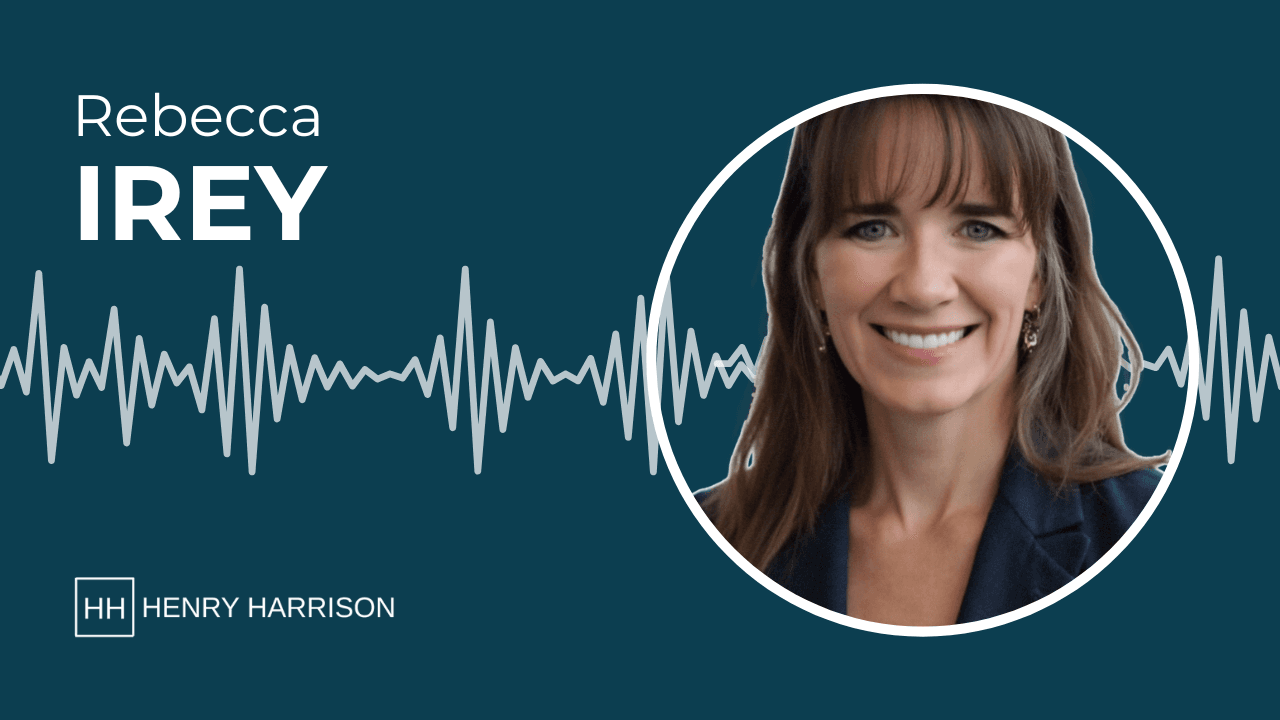
Rebecca Irey
Building Financial Security as an Entrepreneur - Blue Skye Financial
Why Business Owners Struggle With Retirement Planning
In this episode of the Henry Harrison Podcast, Rebecca Irey shares her journey from serial entrepreneur and foster parent to founder of Blue Skye Financial. The conversation explores retirement planning for entrepreneurs, financial resilience, women and wealth, and the hard-earned lessons that come from navigating life-changing adversity.
Watch / Listen
About This Episode
Entrepreneurs are often exceptional at creating income but surprisingly inconsistent at building long-term financial security. In this conversation, Rebecca Irey joins Henry Harrison to discuss why founders, business owners, and high achievers frequently neglect retirement planning while focusing intensely on growing their companies.
Rebecca shares the deeply personal story behind founding Blue Skye Financial after her husband experienced catastrophic liver failure. That life-changing experience reshaped her perspective on money, preparedness, and legacy. What began as a return to her roots in finance evolved into a mission-driven business focused on helping retirees, women, and entrepreneurs prepare for uncertainty before crisis strikes.
The episode also explores the emotional side of financial planning — from the discipline required to save as a business owner to the realities of taxes, succession, caregiving, and long-term wealth distribution. Henry and Rebecca discuss why financial strategy is often less about products and more about relationships, education, and having the right advisory team in place.
Along the way, Rebecca shares stories about growing up on a South Dakota ranch during the Farm Aid era, starting her first business at age 12, relocating to Texas for a more business-friendly environment, and spending years volunteering in foster care and prison ministry.
This conversation is ultimately about resilience, entrepreneurship, and learning how to build financial stability that lasts beyond the next business venture.
Key Insights
Entrepreneurs often tie too much of their wealth directly to their businesses.
Retirement planning requires discipline long before financial success arrives.
Women frequently face unique financial challenges due to caregiving responsibilities and longevity.
Financial planning is about strategy and relationships more than investment products.
Many entrepreneurs underestimate how quickly life circumstances can change.
Financial literacy in America remains dangerously weak across income levels.
Building wealth and learning how to distribute wealth safely are different skill sets.
Vetting financial advisors carefully is essential for long-term success.
Episode Transcript
Disclaimer: This transcript has been edited for clarity, readability, and flow while preserving the original meaning and conversational tone of the discussion. Minor grammatical corrections and filler word removals have been made for an improved reading experience.
Henry Harrison: Welcome to the Henry Harrison Podcast, Entrepreneurs, Business and Finance. Today we’re very lucky to have Rebecca Irey with us. She is the founder and one of the leaders of Blue Skye Financial. She’s also a repeat entrepreneur with a fascinating background.
Rebecca, welcome.
Rebecca Irey: Hey, Henry. I’m so glad to be here. Thanks for having me.
Henry Harrison: Tell us about what you’re doing now, both personally and professionally, especially with Blue Skye Financial. We were talking before the show about family life too, and I know listeners would enjoy hearing about that.
Rebecca Irey: Of course. I founded Blue Skye Financial in 2017 after my husband became seriously ill. We had been business partners since we were basically kids. When that happened, I went back to my first professional love, which was finance.
We officially incorporated in 2020, and now we primarily focus on retirees. I also have a special passion for serving women because life throws women a lot of curveballs. We spend so much time caregiving for children, parents, spouses, and families. Women often save less, earn less, and live longer, which is a difficult combination financially.
I’m a mom of seven and now have six grandchildren. Life can change without warning, and I’ve dedicated a large portion of my career to helping women entrepreneurs, moms, and professionals prepare for those moments.
Entrepreneurs especially tend to be poor retirement planners. We’re rainmakers. We know how to generate income, start businesses, and create opportunities, but we often neglect planning for ourselves.
Henry Harrison: A lot of entrepreneurs probably have most of their wealth tied up in their business. If something happens to that business, it creates real risk.
Rebecca Irey: Exactly. Entrepreneurs are used to saying, “We’ll just make more money. We’ll start another business.” That mindset works until life interrupts your ability or desire to keep operating at that pace.
At some point, you have to intentionally plan for your future. Otherwise, you’re simply hoping things work out.
Henry Harrison: Financial planning starts with priorities and strategy before you even get into investments or portfolios.
Rebecca Irey: Absolutely. First, you have to decide to consistently put money away. Then you decide how to structure it. Entrepreneurs often struggle with that discipline because every dollar looks like an opportunity to reinvest into the business.
Early on, you’re all in. Every dollar goes back into growth. Later, if you become successful, you start getting large tax bills and realize you need advanced planning strategies.
That’s when entrepreneurs begin asking questions like:
How can I reduce taxes legally?
Should I set up a self-directed 401(k)?
What about an HSA or deferred compensation plan?
How do I maximize wealth while minimizing unnecessary taxes?
The IRS becomes your silent business partner if you don’t plan carefully.
Henry Harrison: Even people who make substantial incomes often fail to save effectively. Doctors are known for that sometimes. Professional athletes too.
Rebecca Irey: Entrepreneurs face a unique challenge because there’s no automatic retirement infrastructure. W-2 employees often have retirement contributions automatically deducted through a company plan.
Entrepreneurs have to create that entire structure themselves. That takes initiative, discipline, and education.
Henry Harrison: Tell us about your background and what led you into this work.
Rebecca Irey: I grew up on a ranch in South Dakota during the Farm Aid era. My dad was a hardworking entrepreneur who understood ranching but didn’t fully understand the financial system.
When things went sideways financially, we lost the ranch. That experience left a deep impression on me. I realized early that there are rules to money that people aren’t taught.
After college, I entered finance. Later, my husband became critically ill before I turned 45. I was homeschooling six children when doctors told me he was in complete liver failure.
That changes your perspective overnight.
Suddenly, financial planning isn’t theoretical anymore. It becomes deeply personal. You realize you may not have as much time as you assumed.
That experience ultimately shaped Blue Skye Financial and my mission today.
Henry Harrison: And the earlier people begin saving, the more time value works in their favor.
Rebecca Irey: Exactly, although many people get stuck in what I call the “emergency fund hamster wheel.” They save money, an emergency happens, they spend it, and then they start over again.
Many people never get beyond survival mode into true long-term wealth building.
I also believe the traditional financial system that worked for previous generations is becoming less effective for younger people. Costs are rising faster than wages in many cases.
Henry Harrison: Were you always entrepreneurial growing up?
Rebecca Irey: Completely. My first business started when I was about 12 years old.
I saw a tiny ad in a county newspaper that said, “Send us a dollar and we’ll teach you how to make thousands.” So I mailed them a dollar.
They sent instructions explaining how to place classified ads in newspapers asking other people to send me a dollar. Then I would mail them the same instructions.
One day my dad came home and found the mailbox full of dollar bills from local people. He was horrified.
I had named the company “Wolf Incorporated” after my maiden name because I didn’t know what else to call it.
That was my first business.
Henry Harrison: That’s one of the best first-business stories I’ve heard.
Rebecca Irey: There was no internet, no Google, no Facebook ads. We had county newspapers.
That was marketing.
Henry Harrison: How did you eventually end up in Texas?
Rebecca Irey: My husband was from Minnesota, and Minnesotans are fiercely loyal to Minnesota. But eventually the taxes and business environment became overwhelming.
In 2012, there were multiple tax increases on the ballot. After they passed, my husband looked at me and said, “I guess they don’t want us here.”
We moved to Texas shortly after that, and I absolutely love it here. Texas is incredibly business-friendly compared to where we came from.
The only thing I don’t love is fire ants.
Henry Harrison: Everybody in Texas eventually has a fire ant story.
Rebecca Irey: And chiggers. Nobody warned me about chiggers.
Henry Harrison: You also pursued advanced education later in life.
Rebecca Irey: Yes. My midlife crisis was finishing my education and eventually earning a PhD.
I studied transpersonal psychology and comparative religion through the California Institute for Human Science. I explored Buddhism, Sikhism, indigenous traditions, all kinds of philosophies and spiritual systems.
It had nothing directly to do with finance, but it completely expanded how I think about people and life.
Henry Harrison: You’ve also done extensive volunteer work with foster care and prison ministry.
Rebecca Irey: We fostered children for about 15 years. Our primary goal was keeping sibling groups together because large sibling groups are often separated within the foster system.
At one point we went from six kids to ten kids overnight.
In total, we cared for 37 foster children over the years.
We also served in prison ministry in Texas for many years. That experience profoundly changed my perspective on redemption, opportunity, and human potential.
Ironically, when my husband needed a liver transplant, the donor ended up being someone from a prison where he had volunteered.
Life has strange ways of coming full circle.
Henry Harrison: That’s incredible.
Rebecca Irey: It really was.
Henry Harrison: Your work today seems deeply connected to helping people feel financially secure and empowered.
Rebecca Irey: Financial education in America is honestly terrible. Most people are never taught how money truly works, whether they’re struggling financially or highly successful.
People are told to save money, but very few are taught how to distribute wealth safely in retirement, how taxes affect outcomes, or how investment sequencing works.
That’s what we help people navigate.
Henry Harrison: Before we wrap up, what would you most want listeners to remember?
Rebecca Irey: Financial planning is not really about products. It’s not about crypto, mutual funds, annuities, or any specific investment.
It’s about relationships.
Your financial advisor, CPA, insurance professional, and estate planner should all work together as a coordinated team.
That relationship matters more than any individual financial product.
Find advisors you trust. Vet them carefully. Build a strong team around yourself.
And don’t wait until life forces the issue.
Henry Harrison: Rebecca, thank you so much for joining us.
Rebecca Irey: Thank you, Henry. I really enjoyed it.
Connect with Rebecca Irey
Enjoyed This Episode?
Subscribe to the podcast and never miss an episode. Available on all major platforms.