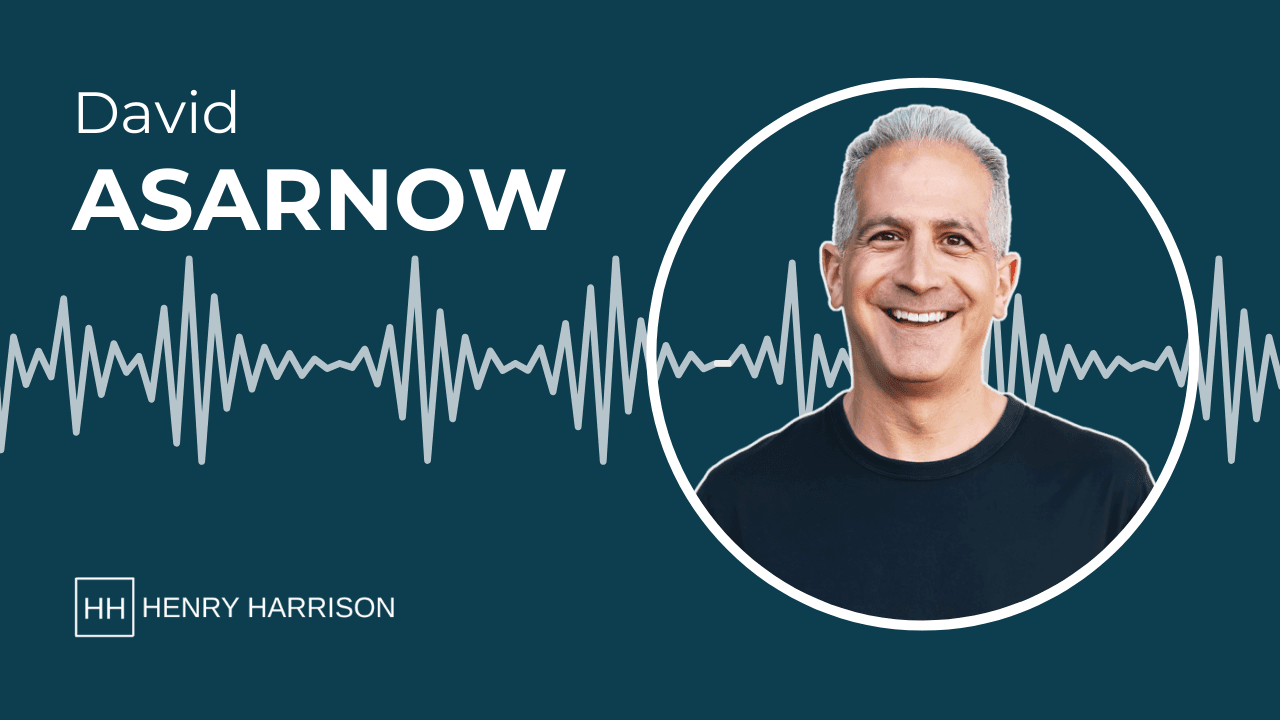
Henry Harrison: Welcome to the next episode of the Henry Harrison Podcast, Entrepreneurs and Finance. We’re fortunate to have David Asarnow on the show today. We have mutual friends we don’t even know about because we’re both members of Entrepreneurs’ Organization, and we both spend time in Atlanta, where David lives.
David has an incredible background—speaking, coaching, building an AI company, leading a major division of a company to growth beyond expectations, and starting his own franchise business about 15 years ago. There’s a lot to cover.
This isn’t Joe Rogan—we normally keep these around 30 minutes, give or take 40. But I have a feeling we could easily go three hours with David. David, thanks for coming on.
David Asarnow: Thanks for having me. I really appreciate it.
Henry Harrison: Let’s start with where you are right now, because you’re doing a number of things we could spend the whole show on.
David Asarnow: Right now I have two companies: Business Nitrogen and Business Nitrogen AI.
I’m excited about companies being able to leverage artificial intelligence to build, grow, and scale. One thing I realized from my years of training is I’m really good at helping people uplevel their teams and talent. I’ve been doing a lot of that lately, and it’s fun.
It started with me training my own team, and now I get to do it for other people and speak at conferences.
Henry Harrison: So Sababa Global is AI?
David Asarnow: I merged that into Business Nitrogen AI. I decided to bring it under the Business Nitrogen branding. I’ve got BusinessNitrogen.com and BusinessNitrogen.ai.
It’s really the same thing. It’s frameworks. It’s understanding the bottlenecks in a business and asking, how do we release those through human intelligence, artificial intelligence, and automation?
Henry Harrison: Interesting. We had someone on our last show who had been on Shark Tank and got deep into AI. He said there are a lot of point solutions—software tools using AI—but fewer people approaching it holistically.
What I’m hearing from you is: how do we take AI across the whole organization, not just one point-specific tool. Am I hearing that right?
You spoke at EO NERVE—the East Coast EO conference. That’s a big event.
David Asarnow: Yeah. I’m blessed they asked me. They could have hired anyone, but they invited me. I ran two workshops.
The funny thing is I had about 250 people at my first workshop. They moved me to the main stage because there were five workshops and over half the attendees were in my room. The next session became standing-room only. They turned people away.
After that, entrepreneurs asked me if I’d help them do two things: develop a plan for their company, and train their team.
I spoke with an EO member out of Charlotte yesterday. He did a company retreat in Mexico and I trained his whole company remotely. Not ideal, but we did a three-hour session.
He told me, “Good news and bad news. Good news is we were in Mexico. Bad news for us—good news for you—you got higher ratings than our outdoor events at the retreat.” He said I was “all the buzz.”
When you get everyone in a company aligned—not just “how do you use ChatGPT,” but how do you use it strategically to make yourself better—everything changes.
I look at it like this: you have a collaboration partner that can challenge you, ask you questions, and help you think differently than you ever have before. You become better as a human.
People ask me, “What should I do?” I tell them: embrace AI because it’s not going away.
Will it replace jobs? Yes. It already is, and it will. The people who are most valuable are the ones who know how to harness it.
So companies should train their teams. And even if your company isn’t asking you to do it, you should invest the time learning how to become better.
Henry Harrison: That’s terrific.
I’ve had consultants who were really good even though they’d never been a home builder—my first entrepreneurial business. They had perspective from seeing so many builders, but part of me still thinks, “You’ve never been an entrepreneur.”
So I like that you not only helped entrepreneurs grow divisions massively—which I want to hear about—but you also started your own franchise business.
You’ve done multiple things: advising, speaking, consulting, corporate growth, and also being a founder. Compare what it was like growing that division versus starting the franchise company—and what it’s like meeting franchise people now who still remember you.
David Asarnow: When I was in corporate America, I started as a district manager. I remember bringing the president of the company around to clients when I was 24.
Afterwards we had lunch, and he said, “You’re not 24. How do you know what you know?”
He said I didn’t handle myself like a 24-year-old. He said I handled myself better than managers in their 50s. He noticed I knew our company, our competition, what made us different, and I had real relationships with the clients. I wasn’t nervous with him in the room.
I told him two things.
First, you’re a person like everyone else. You’re here to grow the company. I’m here to grow the company.
Second, my grandfather gave me advice. I grew up in his business from the time I was four. He used to have me in the room during high-level meetings. After meetings, we’d deconstruct them—what went well, why did I like that person, why didn’t I.
My grandfather told me: when you work for someone else, treat that company like it’s your own. Every dollar you spend, every investment you make—fight for the company’s best interest. People naturally do what’s in their own interest. If you do what’s in the company’s best interest, you’ll rise and you’ll get noticed.
I told the president that, and he said, “David, you’re going to run this company one day.”
And I thought, “No, I’m going to run my own company one day.”
A few years in, I was offered an opportunity to join a startup and head up sales and marketing. They raised capital. They offered me stock. That company eventually exited for about half a billion dollars.
I accepted the offer, resigned from my company, and the VP and president told me, “Don’t announce it. We want to talk to you.”
They asked what it would take to keep me.
I said, “Two things. I need the same earning opportunity because I have a young family. And I want to start a new division. If I stay, I want to build something from scratch.”
They asked what it would look like. I said I wanted to go after large billion-dollar companies in custom plastic packaging—business we weren’t doing.
They said we were too small. I said, “No, we’re not. I can do it.”
They talked, then said, “Done deal.”
I had to call the other company and tell them I wasn’t going. They said, “That’s exactly why we wanted you. We knew your company would fight to keep you.”
I read Built to Last by Jim Collins and Jerry Porras. My sister gave it to me. I highlighted it, dog-eared it, flagged it—everything.
The book talks about companies that outlast having a big, audacious goal.
I created a full business plan: SWOT analysis, positioning, everything. I asked Mark—my leader—if he wanted to review it before I presented to the company. He said no. He said he trusted me.
So I presented.
I talked about our company being 50 years old, doing $68 million, and being better than we were showing up to be. I put up “big, hairy, audacious goal”—BHAG—and said what the division would become.
Then I said: in five years, I’m going to have the largest division in the company. That meant a $40–$45 million division. I also said it would be the most profitable.
I saw the owner look at Mark. Mark turned white. Mark stared at me like, “What are you committing to?” I smiled and kept going.
Afterwards, everyone was joking about BHAG all week. Mark pulled me into his office and wasn’t happy. He said, “What were you doing? You didn’t run this by me.”
I told him, “I gave you the chance. You told me you trust me. Either you trust me, or you fire me right now. Which is it?”
He paused and said, “You better do it.”
Six months in, I was building relationships with the big companies. Mark asked, “Can you close a deal?” He said he put his neck on the line.
I told him, “By the end of the year, we’ll have over $2 million.”
We did $2.2 million.
Within two years, we were at $22 million. At five years, we were over $45 million. We put over $9 million to the company’s bottom line that year.
In five years, I did what I said I was going to do.
I found out later Mark really went to bat for me on some things. I took my grandfather’s words to heart.
There was even a situation where I brought in a concept and opportunity with McDonald’s—over $45 million of business for a product I designed for them. The company said we couldn’t take it on because we didn’t want to invest in the manufacturing equipment. So someone else implemented it.
But overall, I did what I committed to do.
Then I started the franchise business.
The franchise company was owned by private equity. They were looking for a President and CEO.
The person who originally recruited me for the startup role reached out and said, “A private equity group I know is looking. Would you throw your name in?”
I said, “I’ve never been a President and CEO.”
He said, “What you’ve done is more than what many CEOs do.”
Before I met the board, I created a plan of action. It ended up being like a shark-tank-style interview, but I was on one side and five private equity partners were on the other.
It was a four-hour interview. I told them: “You have a story, but a horrible name. You’re not profitable. We can’t franchise until we’re profitable. First we turn it around, then we prepare for franchising.”
I researched the steps and laid out what needed to happen.
At the end I said, “So guys, when do you want to get going?”
I knew one of the other candidates had taken a company public on the NYSE. The competition was serious. So I knew I had to close the room.
They asked, “When can you start?” I said, “Here’s what we’re going to do.”
Once I had a yes, I structured the deal.
I told them, “I don’t want to work for you as a standard President/CEO arrangement. We need to raise capital to franchise, and I don’t think you want to put more money in.”
I proposed raising about $1.4 million. I would do it all. When we got to $750,000, I’d resign from my company and give them 90 days notice out of respect.
In the meantime, I’d work nights, weekends—whatever it took.
They’d receive cash for the company and own a percentage in the new entity. We’d bring in new investors to fund franchise operations and growth.
They agreed.
We got attorneys involved, drafted agreements, and raised capital. I hit $750,000 in under two months, gave notice, and we went.
We turned the business profitable—about a $350,000 swing—within a year.
We rebranded it as Clix Portrait Studios and made the original location a franchise location of the new parent company.
Henry Harrison: Pretty cool.
I hear a recurring theme: conviction, confidence, and planning ahead of time. Would you say those are lessons people should take home?
David Asarnow: I think if you want to do something, you have to believe in yourself.
I wasn’t always this way.
As a teenager I was depressed and didn’t have a lot of confidence. My parents had a very bad relationship and a very bad divorce when I was in my early teens.
Henry Harrison: That would be hard.
David Asarnow: It was. I felt like I didn’t have friends, even though I did. I just wasn’t in a good place.
I remember going to the mall and walking into Waldenbooks. There was a self-help section. For a 16-year-old boy to stop there, you know I was struggling.
I saw a rack of cassettes—dating myself here—and one was white and maroon. It said “Increasing Self-Confidence.”
I bought it. I hid it under my clothes so my dad wouldn’t see. I didn’t want to admit anything was going on.
I listened to it every night. I had a Panasonic tape recorder. When one side ended it made that loud pop and stopped. I’d flip it and play it again.
Thirty days later, I was different.
Was I a different person? Not really—I was the same person. But I started to remember who I was.
That was the seed of understanding the power of the mind. Whatever we see here and believe, we can achieve—but we have to take massive action toward it.
Henry Harrison: That’s inspiring. I believe that and try to live it every day.
A lot of people want a TED Talk. A lot of people want to connect with a famous name.
We had a pre-discussion. Talk about how you turned down one of the biggest names around.
David Asarnow: After the success in franchising—we grew the franchise company to over eight figures in five years—2008 hit and the economy wasn’t going well, but we were still growing.
I was invited to a CEO panel of Atlanta CEOs in franchising. They asked how we were doing it.
I said, “What do you mean? What’s going on with the economy?” I wasn’t reading the news. I was focused.
They asked if I’d be featured in a magazine as one of the “young guns” in franchising. That led to speaking opportunities.
One was the Franchise Times Conference. There were 750 people in the room. I had no formal speaker training.
I got up there with my laptop on the podium. The screen was far away in a long room. I basically read my slides.
People told me I did great, but I felt like I failed.
When I was 22, I watched Tony Robbins on stage—energy, presence, the room responding—and I envisioned doing that one day. What I did was the opposite.
So I invested in speaker training. I went to seminar after seminar and learned how to speak.
Eventually I resigned from the franchise company to become a speaker.
At a training, the group introduced Ted Miller, who was VP at Business Breakthroughs International, owned by Tony Robbins and Chet Holmes.
Ted asked if anyone had been on their workshops. I raised my hand. He remembered my company.
He said they were looking for additional speakers. They wanted weekend speakers to continue, and weekday speakers to speak to corporations and entrepreneurs.
Ted asked why I didn’t raise my hand to be a speaker on their team. He said I’d be perfect.
I told him I wanted to build my own name. I wanted to do it on my own.
He said I could still build my name while working with them. I said I appreciated it, but I wanted to prove it to myself.
Ninety days later I ran into Ted and Chet Holmes at an event called Speakers Authors Networking Group.
Ted introduced me to Chet. Chet said I should come work with them, as a coach or consultant.
He asked for my email and number. I gave it to him.
A couple days later, Chet emailed me: “David, this is Chet Holmes. Your website sucks. You should come work for us. Seriously.”
I replied back and thanked him.
A couple months later, I wasn’t getting the speaking gigs I expected. I called Ted and asked if the offer was still there.
He said yes.
At first I wasn’t good because I had to learn their pitch and their style. But within 90 days, I was enrolling more people in their programs than anyone else—about a 63.4% increase over the average.
That experience shaped who I am today.
I worked with entrepreneurs in every kind of setting—from 200-person events to eight-person rooms. I taught marketing, sales, time management—core growth principles.
But more importantly, I’d ask: “Tell me what you’re doing. Tell me your problem.” Then I had to solve problems live in front of the room.
That showed people the value of implementation, and what it’s worth when someone helps guide execution.
Henry Harrison: I’m guessing because he’s a celebrity, you interacted with Tony Robbins?
David Asarnow: No, I didn’t. I may have sold millions of dollars for him, but I never interacted with him.
I did interact with Chet.
When Chet had cancer, he couldn’t go to some events, and I filled in for him a few times.
There was a franchise conference he didn’t want to attend. He said franchisees won’t invest in coaching programs.
I disagreed. I told him there was no risk—if I sold anything, he wins too.
I said I’d been a franchisee and a franchisor. I could speak their language. I could solve their problems in a room of 200 people.
He said, “If you want to go, go.”
I sold $65,000 in coaching at that event.
Henry Harrison: I’ll say.
What was it like giving a TED Talk?
David Asarnow: That was the hardest talk I ever gave.
I applied. The process wasn’t what you’d think. I did TEDx at Emory University.
I got an interview, and it was a college sophomore interviewing me. They asked about my idea and what would make it unique.
They said, “We have a lot of applicants. If you’re selected, we’ll let you know. If not, apply next year.”
I assumed I got turned down.
Two days passed. Two weeks passed. I thought it was over.
Then on January 1st I got an email: “Congratulations, we’d like to invite you to speak February 15th.”
That gave me 45 days.
I hadn’t written the talk. I never memorize talks—I usually know the topics and flow based on the room.
But a TED Talk lives on the internet forever. No do-overs.
I hired a TEDx coach to help structure it.
I canceled almost every meeting from January 15th to February 15th and practiced constantly. I needed it to feel natural, conversational—because TED Talks are idea-driven conversations.
On the day, it was the first time my family ever saw me do that. My mom, kids, and wife were there.
Some stories I told were the first time I’d ever shared them live. I did that on purpose because I wanted to feel the emotion while I delivered them.
Henry Harrison: That’s a neat approach.
So here you are—with this history of success, personal growth, and helping companies at different levels. What’s on the horizon? I don’t see you stopping anytime soon.
David Asarnow: I’m not stopping.
I still do growth consulting. People see me speak on AI and hire me to build an AI plan.
But when I do that, I can’t help weaving AI strategy into business strategy and marketing strategy, because that’s ingrained.
A lot of times they hire me for “help us grow” and AI is part of it.
I have a PhD leading our AI division, and he can build whatever we come up with.
Right now I’m having a lot of fun speaking and helping companies implement.
I’m doing AI keynotes. I was invited to speak in Brazil at a 500-person event. I’m doing main stage plus two breakout workshops.
What I’m teaching is this: it’s not about AI tools. Tools come and go.
We need to learn the psychology of communicating with AI—whether it’s ChatGPT, Gemini, Grok, Manus, Perplexity—whatever.
If you can communicate well, the skills transfer across platforms.
These tools are evolving so fast that the app itself becomes less important. If you get good at the fundamentals, you’re set up well.
I’m also launching training programs for people who don’t have the budget for one-on-one consulting.
That’s what I’m working on now.
Henry Harrison: Terrific.
We had Anthony Franco on—he was on Shark Tank—and he’s doing AI work too. He had a venture that didn’t go well, and he has an interesting perspective: entrepreneurship may not be for everyone. It can be brutal.
I’ve heard similar from a founder who sold a major company to Coca-Cola. He said they were close to bankruptcy for years.
So I love the term “intrapreneur.” Take entrepreneurial concepts, treat the company like it’s yours, and that might be the best path to achieve big goals and create prosperity.
You’re helping people across a wide range.
David Asarnow: I was an entrepreneur, and it’s not a bad place to be.
But before someone steps into entrepreneurship, you have to understand: you have to make payroll. You have to figure everything out.
You’ll go years—often—before you’re making real profit. There’s struggle. Only do it if you really want it, because you’ll work more hours and make less per hour, typically, at least for the first five years—sometimes ten or more.
Then success can come.
Intrapreneurship is a similar mindset. If you’re a great intrapreneur inside a company, you get noticed and you get opportunities, because not everyone is wired that way.
Henry Harrison: Not everyone is like that.
Before we wrap up—those plaques behind you look interesting. They must mean something.
What are they?
David Asarnow: Those are awards from ClickFunnels. It’s a marketing funnel builder software.
Each of those awards represents funnels that did over $10 million each.
Henry Harrison: Wow. That’s terrific.
David Asarnow: Yeah, it’s one of the tools we’ve used over the years. I’m tool-agnostic.
Henry Harrison: I like the mindset—whether you’re an entrepreneur or intrapreneur—wanting to create, build, and achieve big goals. Big, hairy, audacious goals.
David Asarnow: Big, hairy, audacious goals—no matter what you’re doing, do it.
One upside of being an employee is you can clock out. You’re not working weekends. You may actually be on vacation.
I was hiking with my son in Nepal. I told everyone I’d be unavailable.
I got a text message—and unfortunately I had internet. There was a fire, and I had to put it out. I was probably around 12,000 feet up on a mountain when I was dealing with that, in a village.
Henry Harrison: That’s a good place to wrap up.
David, thank you for coming on. This was terrific. I know people will get real value out of it.
David Asarnow: My pleasure. Thank you for having me.