Amy Ledgister
Building a Beauty College From Scratch: Amy Ledgister on Delegation, Regulation, and Designing Your Exit
A founder's honest account of what it actually takes to grow a licensed education business — and how to build one that runs without you.
Amy Ledgister left a decade-long career in dental hygiene to build 3D Lash & Brow, a private beauty college that has graduated thousands of women since 2018. She joins Henry Harrison to talk about surviving a regulatory shutdown, scaling through COVID, learning to delegate, and her plan to franchise by 2027.
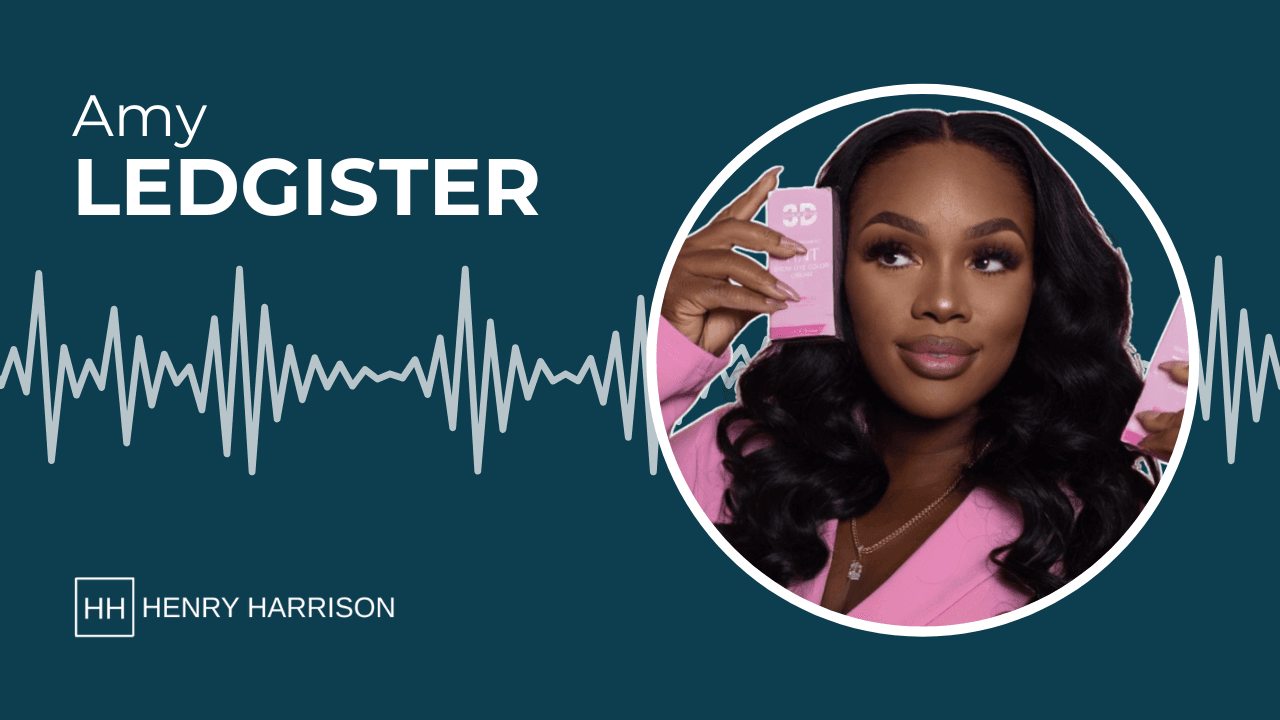
Watch / Listen
About This Episode
Amy Ledgister spent ten years as a dental hygienist earning $40 an hour. A chance encounter with a lash artist — bartering beauty services for dental work in a Dallas practice — showed her a different path. She enrolled in night school, and within six months her lash and brow work was earning $400 an hour. That leap became 3D Lash & Brow, a private beauty college she founded in 2018 with campuses in Dallas and Forney, Texas.
In this conversation, Amy walks Henry through the unglamorous middle of entrepreneurship: the years she worked 7 AM to 9 PM as teacher, janitor, financial aid officer, and HR department in one. She explains how COVID forced the school online — a pivot that grew enrollment 60% — and what happened when the state abruptly banned online programs, forcing her to petition Governor Abbott to protect 200 enrolled students.
Amy also breaks down the business mechanics most people never see: why new beauty schools can't access government funding for their first two years, what accreditation really costs in time and red tape, and why a school owner effectively becomes a lender once students take on financial aid.
Now a graduate of the Goldman Sachs 10,000 Small Businesses program, Amy is engineering her own exit — stepping back from CEO to founder and visionary, mentoring more than ten women who have opened their own schools, and preparing to franchise her first location in January 2027. It's a candid look at building a business designed to outlast its founder.
Key Insights
Hire before you think you can afford to. Amy's rule for new school owners: bring on an admin team early. Delegation pays for itself, and waiting means the founder becomes the bottleneck in every function.
Systems break at scale — build them before growth arrives. A 60% enrollment surge during COVID exposed gaps in processes that worked fine when the school was small. Prepare infrastructure for the business you want, not the one you have.
Regulation is a business risk, not a background detail. A single state rule change forced Amy to drop 200 registered students and lobby the governor's office. In licensed industries, regulatory monitoring and relationships are survival skills.
Cash-pay revenue precedes institutional funding. New beauty schools are ineligible for government funding for their first two years. Founders in accredited-education businesses must plan for a lean, cash-dependent launch phase.
Accreditation turns you into a bank. Once students borrow, the school owner is responsible for tracking job placement and repayment. The grant revenue is lucrative, but it comes with a permanent operational workload.
Structured time away improves the business. The Goldman Sachs 10,000 Small Businesses program required giving up Thursdays and Fridays for five months — proof the company could run without her. Amy kept the practice after graduating.
Culture means a standard you enforce every time. Amy defines culture as consistent excellence — every student greeted, every interaction held to the same bar — because many students arrive carrying heavy circumstances and need the school to feel like a safe haven.
Design your exit early. Exiting doesn't have to mean selling. Amy is transitioning from CEO to founder-visionary and packaging her systems into a franchise model launching January 2027 — turning eight years of hard lessons into a product.
Episode Transcript
Cleaned & Rewritten Transcript
This transcript has been lightly edited for readability, with filler words removed and sentence structure improved. The original meaning and conversational tone have been preserved.
Henry Harrison: Welcome to the Henry Harrison Podcast — entrepreneurs, business, and finance. Today we are very fortunate to have Amy Ledgister with us. She's going to tell us about her school, which is really neat. She is an entrepreneur. Thanks for coming on. Hello, Amy.
Amy Ledgister: Hey, thank you so much for having me. This is such an honor. I'm super excited.
Henry Harrison: This is a good one for me, because this is definitely not something I know much about — which makes it more fun. 3D Lash & Brow is the name of the company, and that's actually the website as well if you want to look it up: spelled out as the number 3, the letter D, Lash and Brow dot com (https://www.3dlashandbrow.com/). It's a salon and academy. From my understanding, it's a pretty significant business. I just looked online — it looks like you've got about 20 rooms in one location for teaching, then a whole other location, and people in and out all the time. Maybe just talk about what you do and what the school does.
Amy Ledgister: Yes. My name is Amy Ledgister. I am the founder and CEO of 3D Lash & Brow. We are a private beauty college located in Dallas, Texas, as well as in Forney, Texas. We help women get licensure in beauty careers — from estheticians to cosmetologists — and we help them graduate and start a new journey.
We started in 2018, and since then we've graduated thousands of women. Many of them have started their own businesses or work for really successful salons or med spas. I've been on this journey going on 12 years now, and I've learned so much. It's very exciting to see women start and grow in their journeys.
Henry Harrison: I looked, and you went to Wichita State University. Where are you from originally?
Amy Ledgister: I am from Wichita, Kansas. I was actually a dental hygienist.
Henry Harrison: So I think you must have had some interest in appearance and health and things like that. But what was the journey from there? Did you actually work in that field for a while before learning what you needed to potentially start a business?
Amy Ledgister: Yes. I started off as a dental hygienist, and I did that for 10 years. I loved it. I always knew that I wanted to be my own boss — I just didn't know what that looked like — and I've always loved beauty.
I was blessed to work for Dr. Mary Swift in Dallas, Texas. She would actually barter: if you were a cosmetologist and didn't have dental insurance, you could work off your balance by providing beauty services to her and the staff. That's how I discovered lash extensions. There was a lash artist who came in to get her Invisalign and her teeth whitened, and she started doing our lashes.
I remember the very first time I went to get my lashes done. She had a cute little room with a little bed — this was before lashes were as big as they are now. I got my lashes done and started thinking to myself, "Wow, maybe I could do this. I could have my own little suite." Texas is the only state where you can get a license in just lashes. So I went to school at night while doing dental hygiene during the day, and within six months I was able to build my business to where I could leave my dental hygiene job making $40 an hour to doing lashes and brows making $400 an hour.
Henry Harrison: Wow, that's a big jump. You said you always wanted to own your own business. Was that something that started when you began working, or something you thought about as a kid, or something your family encouraged? Where did that inspiration come from, as far as you can tell?
Amy Ledgister: That's a great question. Looking back, I realize that I always loved sales, and I always loved movies like She-Devil with Roseanne Barr, where she creates her own organization, or Don't Tell Mom the Babysitter's Dead, where she goes into the corporate world and creates her own fashion empire. I grew up watching those kinds of movies and seeing how cool it would be to run your own thing.
As a little girl, I remember my stepdad worked for JCPenney, and he would bring home extra things from the warehouse — like extra sunglasses they weren't going to sell — and give them to me. Instead of just putting them on, I remember going out on my patio and trying to sell them to people in the apartment complex. That was the very first time I realized: oh, I like to sell. I didn't know I would create the empire I have today, or what would be required to do that, but I always knew I loved having my own thing.
Henry Harrison: I think that's a recurring theme among the entrepreneurs we've had on the show and the ones I've known — nobody knows what's required to create that empire when they step into it. Nobody knows the challenges and difficulties they're going to face, or the wonderful celebrations and accomplishments. And you mentioned how gratifying it must be to see all these women better themselves. Are they mostly women today?
Amy Ledgister: Yes — I would say 98%.
Henry Harrison: So what were those "didn't realize what it would take" moments?
Amy Ledgister: There are so many. When I first opened my school, I wanted to create it for the working adult, because when I was going to school, I was working and needed a flexible schedule. So I wanted to have night programs. But I realized that if you have a night program, you have to be there at night as well.
I didn't know the power of delegation. I just didn't have a blueprint. When I first opened my school, I thought, "Oh, I love to teach" — but I was wearing so many different hats. I was the janitor, the laundry, financial aid, HR, a teacher, and marketing. I was wearing all these hats while running a night program and a day program, so I was literally there from 7 AM until 9 PM, Monday through Friday, plus Saturdays.
It was a lot, until I learned that in order to really succeed, you have to let go of the reins a bit. So I started to hire, and that took a lot of weight off me once I started to delegate. However, hiring became a new form of challenge — learning how to manage people and manage teams. It's been quite the journey.
Henry Harrison: My first business was a custom home building business, and I'm not really very handy — you wouldn't want me climbing on the roof nailing things up. I went to college and got an MBA; that was my journey. I started right out of college working for a big home builder where they trained me. But I remember some of the guys — framers, carpenters — who trained us on what to look for. I wasn't literally building anything, and I was sometimes envious of the people who could look at certain things and know, because they knew how to put it up. They could have stepped in and said, "Let me show you how to do this," and that wasn't something I could do. I'm sure knowing all aspects of the business because you did it all yourself has also served you.
Amy Ledgister: Oh, yes. As you said, when you're starting new, you're just learning — and you never stop learning no matter what stage you're in. Businesses change. Regulations change. All of that changes. I definitely learned a lot about myself and about people, learning to manage different things. It was eye-opening for sure.
Like I said, when I first started, I was the only instructor. Once I hired an instructor, I was able to grow that much more. One of the things I always tell my mentees — because now I help other people open their own schools — is do not wait on hiring an admin team, or even just an admin assistant. Just hire. It will pay for itself.
Henry Harrison: That's good advice. So when people come to your school, I imagine there are all different goals — and thousands of people, you said, have come through. That's a lot of people. How does it work when you help people start their own schools? Is that a separate business, or do you just get to know some people and decide to help them?
Amy Ledgister: People seek me out — from social media, mostly. They reach out and say, "Hey, I would love to own a school. Can you help me?" I didn't realize that was a business within itself, so I created a whole consulting package for future school owners. I've helped probably over 10 women now open their own beauty schools and succeed.
I always say I wish I had a mentor when I first opened my school. It just wasn't a thing — it's kind of a niche business, being a beauty school owner. So this is also a way for me to give back: to teach what I learned along this journey and hopefully help them prevent some of the mistakes I made, some of the money I lost, some of the heartache and pain. If I can help just one person, that means the world to me.
Henry Harrison: That is so neat — really inspiring. When you mentioned keeping up with regulations, I got a headache just thinking about it. That seems like a pretty important job, necessary and full of pitfalls if you don't follow it closely.
Amy Ledgister: Oh yeah, it can be a true nightmare. I've definitely had some incidents. During COVID was when I had just started my school — I started the school, and then COVID hit. Here I am, a toddler finally getting the groove of walking in my business, and then the pandemic hit.
I had to navigate going completely online, which — believe it or not — actually increased our enrollment 60%, because now people could register from all over the US, not just Texas. So I was running basically two schools at that time: students who wanted to come on campus, and students who were online. We did that for about two years straight, all approved by the state.
Then one day we got an email saying all online education had to cease, and I was required to drop about 200 students who had registered and just started, because of a swift new rule: no more online education. I had to petition Governor Abbott. I went to all of my senators to try to get the state board to allow my students to continue their programs. So yes, I've had some run-ins with this. Regulations and their changes definitely impact your industry.
Henry Harrison: That's a doozy. So now, as you mentioned before we started the podcast, people can start online, but they'll need to spend some time at the actual school. And with those two locations, they could come in from a relatively far distance — that doesn't matter.
Amy Ledgister: Right, it's very flexible. Again, I created it for the working adult. Now in Texas you can do 50% of your program online, which still gives people a great opportunity to get their hours and finish their program with flexibility if they work or have kids.
Henry Harrison: What a time to start a business — right before COVID.
Amy Ledgister: I know. One of my favorite pastors is T.D. Jakes, and he mentions that you have to be prepared for the famine and the feast. During that pandemic time, it was of course odd having to transition to online, but once I learned how to pivot, I could see that people were registering from all over because it was open.
And although that was great, it was such a flood of students at once that I didn't necessarily have the systems in place — the things you think about when your business is smaller and growing. So here I was navigating a huge increase in business while still in year two. Quite the journey.
Henry Harrison: And you need accountants, tax advisors, bookkeepers, teachers — and like you said, janitors, because you've got a large facility. Furniture, supplies for your classes. I can imagine what happens if you run out of supplies when everybody shows up for class.
Amy Ledgister: Yes. You cannot have that. And students want what they want when they want it. In their minds, they're paying for a certain thing, so they're not always giving as much grace as some people. You have to make sure you're on top of everything when it comes to running a beauty school.
Henry Harrison: I love listening to T.D. Jakes. It's been a long time, but I listened to him online. He has a way of talking about something, then bringing in a story, then circling back, and then there's another one that ties in — I thought it was amazing. For a while there, I probably listened to 20 or 30 hours of his sermons. Is he still around?
Amy Ledgister: He is. He just stepped down, so now his daughter has taken over his congregation. But he still has his online ministry, and he still preaches all over. I enjoy him. I feel like a lot of his sermons got me through some of the difficulties of being an entrepreneur, because he speaks a lot to the entrepreneur.
As we know, when you start a business, you don't know what's required. I remember year one — just learning and navigating. I remember crying for about six months straight because it was so overwhelming. I thought, "Oh, I love to teach — let me open a school." But teaching was the least of what I got to do. It was navigating everything else, like having staff. T.D. Jakes' sermons were always on point for me.
Henry Harrison: Are there beauty schools around the country with any informal or formal network — conferences or associations, anything like that?
Amy Ledgister: No, there really aren't any conferences specifically for school owners. However, when your school is ready to get accredited — to be able to offer financial aid — there are conferences catered toward that, and you get to meet schools from all over the US at these accreditation events. But for school ownership alone, no, you don't get to meet too many people.
It can be kind of a lonely journey, which is why I think I have so many people reaching out to me now. I'm heavy on social media, posting about this journey and giving tips on how to succeed as a new school owner.
Henry Harrison: I can see why they would — I would if I were looking for it, just from meeting you in this short time. What a blessing to get your help. And I imagine the whole financial aid thing is a whole other business in and of itself, because you've got to see if you're going to get paid back and who's the right person to essentially invest in. Presumably it's people who don't have enough money to go through the program, but they'll make more money once they get their license — so you try to create a win-win. It sounds like you may do some charity as well, but it can't all be charity; if it were, you'd go out of business. What is that like? Is there guidance somewhere?
Amy Ledgister: That's a good question, because for the first two years after you open a beauty school, you're not even eligible for government funding for your students. So it's all cash pay, which, as you know, can fluctuate depending on what students are going through. There are students who pay, but it's not as stable as it becomes once you're accredited.
Once you do become accredited, you have to decide if you're going to be a bank — because once people get loans, your responsibility as a school owner is to ensure that they go to work and pay back those loans. You become the banker: getting people to pay things back, keeping up with them and their job placement. If your school decides to become accredited, it's another part-time job. It can be very lucrative because you're getting grants from the government, but it's a lot of work and a lot of red tape.
Henry Harrison: Wow. Well, do you get any time to teach anymore?
Amy Ledgister: I do occasionally — specialty classes, like certifications — but not the day-to-day classes or longer programs. Our longest program is 1,000 hours; that's cosmetology, which takes about six months. I might pop in here or there, but I'm running everything behind the scenes.
Henry Harrison: Well, you're basically teaching everybody. You're making sure the teachers are taught, the students are taught, the people who are borrowing understand what that means — and now you're teaching other business owners and business owners-to-be. It's just different from actually going in and teaching about lashes like you did in the beginning.
Amy Ledgister: So true. And because we are a family-owned business, even though I'm the one in the school, my husband helps as CFO, and my daughter — she's 20 now — is a licensed instructor at the school. Students get to see us, and I think it helps inspire people: hey, if they can do it, we can do it. I've gotten feedback that it's inspiring to see that.
Henry Harrison: I'm glad you brought that up, because I didn't know about that. Your daughter and your husband — so you have a bit of a legacy you're creating, not just for your students and those starting businesses, but also for yourself. Do you ever get a vacation?
Amy Ledgister: Working on it. Now that I'm fully staffed and have a really great team — some people have been with me almost seven years, and we know each other well, plus my amazing husband and daughter — I could use way more vacation.
But I recently graduated from the Goldman Sachs 10,000 Small Businesses program. I don't know if you've heard of that.
Henry Harrison: Oh, I have heard of that. Fantastic — well done.
Amy Ledgister: Thank you. In that cohort, they teach you things like planning your year and planning your vacations. The program is about five months long, and you have to give up pretty much every Thursday and Friday — which, as a business owner, is a big deal to let go of. But it helps you learn that your business can run without you. I've kept those Thursdays and Fridays going since I graduated. The world is not going to fall apart if I'm not there every minute.
Henry Harrison: I've got to think — because I know it's this way for me — that there's benefit to some of that time where maybe you're not literally completing a task, but you're thinking about things. You're giving yourself time to reflect, have some perspective, and hopefully make better decisions because of it. Does that ring true with you?
Amy Ledgister: Oh yes, absolutely. Not just the fact that I was in a cohort dedicated to business, around other business owners to bounce ideas off of and hear what works for them — but as you said, we can be so focused working in the business that we're not working on the business. When you take a step back, you can really see the gaps and what's needed. It also gives you a moment to pat yourself on the back, because sometimes we focus so much on what's not going well that we don't see how well things are actually running.
Henry Harrison: So what do you see in the future? You've just completed this program, and you're looking at things anew. It's been seven or eight years since you started, but you're a young person — you and your family could have this business for many years. What's your plan for the next 10, 20 years and longer?
Amy Ledgister: They really emphasize: what's your exit plan? And they explain there are multiple types of exits. Sometimes just exiting from CEO is an exit — you're no longer running the operations. That's what I'm working toward: exiting from CEO so that I'm founder and visionary.
And I'm actually working on franchising. This past year of being in school and taking a step back, I saw things that were running really well and things that would help other school owners. Instead of having to do it all by yourself, if I've already created the systems, I can package them so other people can step in and enjoy the benefits of being a school owner without as much pain. There's always going to be a little bit of work in any business, but if I can fine-tune it to make it more enjoyable and more accessible — as opposed to eight years of ups and downs — that's a big goal for me. I plan to franchise my first location in January 2027.
Henry Harrison: Wow, congratulations. Is your stepfather, or some of your relatives who knew you before you started all this, still around? Are they proud of their Amy?
Amy Ledgister: I wish. No — but my grandparents, before they passed, were proud of me. I know they're looking down and are proud of me. And my younger daughters are the next generation.
Henry Harrison: That's where the future is, right? Tell me about your daughters — I interrupted you earlier.
Amy Ledgister: I have three: a 20-year-old, an eight-year-old, and a two-year-old. My eight-year-old watches me. She says, "I want to be a boss babe." I'm always telling my 20-year-old, "Hey, I need you to take over at some point." She's not that interested. But my middle one says, "I'll take over, Mom." I don't know what that will look like once she gets to that age, but she's very inspired and excited.
Henry Harrison: So you really are a superwoman — you had a baby in the middle of all this too.
Amy Ledgister: I did — right when we opened our second location. And that's a journey in itself, opening more than one location, because you're really splitting yourself in half. I didn't realize that until I did it.
Henry Harrison: A lot of people struggle with that. You can't be in both places at the same time.
Amy Ledgister: You cannot. And sometimes when you're not at one location, you can see where things slip. That's something I've worked on for the past couple of years: how do I keep my culture and my standards at both locations without wearing myself thin — especially as a new mom, and of course as an awesome wife? How do I maintain those standards? That's one of the things I've been working on, and I learned a lot through the different programs I took this year.
Henry Harrison: When you talk about culture — I could pull up the website, but tell me your thoughts on that, because that's obviously an important part of a successful company: having a place where people like to work, people like to come, and people get what they're looking for. Sometimes they don't know what they're looking for, and you have to help them.
Amy Ledgister: That is so true. When I first heard the term "culture," I really didn't know what it meant in a work context — you hear it so much. For me, I made it mean standard: how we operate here is with excellence. I'm a believer, so I think anything you do with your hands, do it as if you're doing it unto the Lord.
I want that from the moment people walk in — they're greeted, and we want them to feel like we're happy to be there and happy to see them. A lot of these students are carrying so much weight. Some of them are single moms. I have women who are currently in shelters, who are homeless. I have very young students. You have students carrying a lot into the school, and you want it to feel like a safe haven for them — but at the same time, you want to make sure they come to learn and get what they need to be successful.
So as far as culture: making sure we operate in excellence, from staff to students. We hold them accountable, but we also allow them to just be, and to be seen.
Henry Harrison: All those people coming to take classes are taking on a new challenge, a new journey. They're probably intimidated, scared — but they're taking that step. I can tell you, if they met you, they'd feel warm and right at home. That's probably what you want to pass on — that everybody can be like that.
Amy Ledgister: Yes, thank you. That's what we want. We want them to feel accepted, warm, and happy. We want them to enjoy their time — even though it's maybe three to six months, that's still a long enough time. And the same goes for our instructors. We want them to enjoy their jobs too, because they're the ones really pouring into the students every day. So we want to make sure we pour into their cups as well.
Henry Harrison: I've had people who were at homeless shelters work for me — not very many, a couple of instances. They didn't tell me; I figured it out, and that was okay with me. They got back on their feet, so it was a good thing, and I'm proud of that. Probably nowhere near what you're dealing with, but I can empathize, at least from my one or two small examples, with what you must see.
I was going to tell a story about Sam Walton — the largest company in the world, and still probably the richest family in the world if you add them all up. Maybe Elon Musk has topped them at this point, but prior to that, it was them. He hired the greeters in Walmart to say hello when you came in. He used to say that if everybody in the store was friendly, sales would go up — and he had some huge number, like 10%, just from making people feel welcome in Walmart.
I know at my health club, they always say as you walk out, "Goodbye — see you tomorrow." They do it every time. It's a pretty well-run health club. Even though I know they're doing it for business, and they're told to do it, they're smiling and seem to be into it — and it makes me feel good. Yeah, come back tomorrow.
Amy Ledgister: Yes. Thank you for sharing that — I didn't even know that about Walmart and Sam Walton. But it's so true, just being greeted, and consistently. From a business owner's perspective, you know that there's a culture or a standard that has to be met every time. So even if you know they're doing it for their job, you know somebody cares enough to make sure it's happening. That's pretty awesome.
Henry Harrison: You mentioned greeting people when they come in — that's why I brought up the Walmart greeter; that was his idea. So you didn't even know it, but you have the same way of thinking as the guy who became the richest man in the world.
Amy Ledgister: It makes a difference — how you treat people. Sometimes it's not even so much the product; it's how people remember how they felt. That's what I want. It's not always going to work that way — you cannot please everybody. I quickly learned that.
Henry Harrison: That's right. You can have too-high expectations, because life has a way of showing up in ways you don't want sometimes. Well, what else would you like to share — about the school, for people who might be interested, and for other business owners?
Amy Ledgister: If you're interested in joining a beauty career — we have a lot of people who come to us for second-choice careers: nurses wanting to change, teachers wanting to retire and get into something else that's more customer-service oriented. Our esthetician program is our number one. It's a great opportunity. You can visit us on our website at 3Dlashandbrow.com and send us a message, and we'll schedule a virtual consultation and answer any questions you might have.
Or if you've ever thought about owning your own beauty school or salon, you can reach out the same way at 3Dlashandbrow.com, or go to my other website, AspireWithAmy.com, and send me a message. I would love to help you, give you some guidance, and share some tips.
What I'd like to share is this: if you are an entrepreneur, you've just got to keep going. It can be very challenging. So keep going, and find a mentor — even if it's listening to this podcast or other podcasts, or getting books. Find a way to make it through. Like I mentioned, we've graduated thousands of women, and I know that if I had given up in year one, I wouldn't have the success I have today. And even today, I'm still learning. So continue to learn, continue to seek mentorship, and give it all to God.
Henry Harrison: What a fantastic way to wrap up. Thank you so much for coming on. I know people are going to love this.
Amy Ledgister: Thank you for having me. I really appreciate it.
Enjoyed This Episode?
Subscribe to the podcast and never miss an episode. Available on all major platforms.